At dusk, as the skies turn shadowy, you could be treated to the most amazing spectacle imaginable this autumn, as flocks of birds perform shapeshifting sky art.
We’ve explored these stunning starling-filled spectacles and looked at some of the ways that self-forming functions can build on their brilliant behaviours…
According to the RSPB, magical murmurations happen when,
‘hundreds or even thousands of starlings come together in a breathtaking improvised aerial dance. They swoop, ascend, dive, and lift in a cloud of orchestrated patterns that once led scientists to theorise that starlings must have physic powers.’
These days, it’s believed that starlings murmurate for many reasons, including warmth and safety, but most importantly, for information exchange. Rather than replicating a bunch of boisterous bumper cars, starlings in murmuration exhibit coordinated, synchronised movements to communicate with one another – all without a supervisor in sight!
It’s like Mother Nature’s very own version of a self-organising team or impact network – a free-flowing, problem-solving, solution-generating group with decision-making distributed evenly and communication working in harmony. And the result? Genuine collaboration, inclusivity, trust, psychological safety and a sense of warmth and wellbeing that leads to stronger, safer teams.
What can we learn from these magnificent murmurations and their living-systems approach to forming and functioning? And how can we simulate some of the ways in which they bring people together to build relationships, leverage skills and strengths and shun silos?
Enabling the free flow of information and ideas
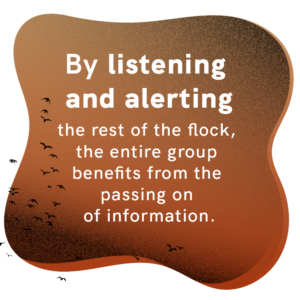
Starlings are really good at being able to understand what’s happening around them – and they have strong motor responses to adjust to it and communicate it. These magical murmurations create the right conditions to pass on diverse information like the presence of danger lurking in the skies or updates on the best feeding sites to visit. By listening to their direct neighbours and then alerting the rest of the flock, the entire group benefits from the passing on of information based on the shortest possible communication circuit that makes sense for the team.
How can we replicate this? It all comes down to establishing clear, open channels of communication where team members are perfectly in tune with one another and feel comfortable sharing their thoughts and ideas. What works well for one team may not be the best approach for another, so ask people about their preferences. A basic review of comms channels can reveal hidden surprises, help to streamline those channels that aren’t serving you well and introduce simpler methods that allow for seamless information sharing.
Looking out for one another 
The way these birds gather for warmth is a beautiful example of collective support and unity for mutual benefit. The natural tendency is to demonstrate care and courtesy – avoiding crowding one another and building harmonious buddy-systems, all to keep each other safe and well. Much like starling murmurations, self-forming teams will exhibit qualities such as cooperation, trust, and mutual support. Teams that prioritise collective wellbeing can achieve remarkable results through respect, synergy and consistent collaboration.
How can we replicate this? Any successful team that prioritises the wellbeing of its members will display a high degree of mutual trust and respect, common values and principles are shared and members enjoy healthy, positive relationships with their peers.
Some other key factors include continuous learning opportunities being promoted and encouraged, open conversations around common wellbeing challenges being normalised, differences being valued and celebrated and positive boundaries being maintained with the setting of clear work life balance standards.
Promoting inclusivity and respect
Murmurations happen with no leader and follow no plan. Instead, scientists believe a murmuration is a visual invitation to attract other starlings to join a group, achieving communal benefits through a sort of unspoken collaboration. These ‘autonomous vehicles’ travel in tight formation yet are made up of many individual contributors, each bringing their own strengths to the party, as individual birds are quietly given the space they need to move and manoeuvre. Nobody is questioned over the value they offer, but all are respected for the collective power they bring about.
How can we replicate this? In workplace settings, we can recognise and appreciate the diverse skills and strengths of team members by allocating tasks and responsibilities that reflect each individual’s unique abilities. Everyone adds value! One way to do this is by recording and promoting those strengths for all to see. The Manual of Me is a great example of this, where learning more about each other’s strengths and styles can help groups cultivate and perfect their approach to working together. Follow a similar template to the one shared here by Future London Academy, adapt it to suit your team’s needs and take advantage of the benefits created!
See for yourself
Autumn roosts generally start to form in November, you can explore roost sites and find a murmuration map here: https://www.starlingsintheuk.co.uk.
And while you watch in wonderment, take a moment to reflect on the broad benefits of these glorious aerial gatherings and how they could be ingrained beyond these magical murmuration moments.
By Caroline Roodhouse for Alive!