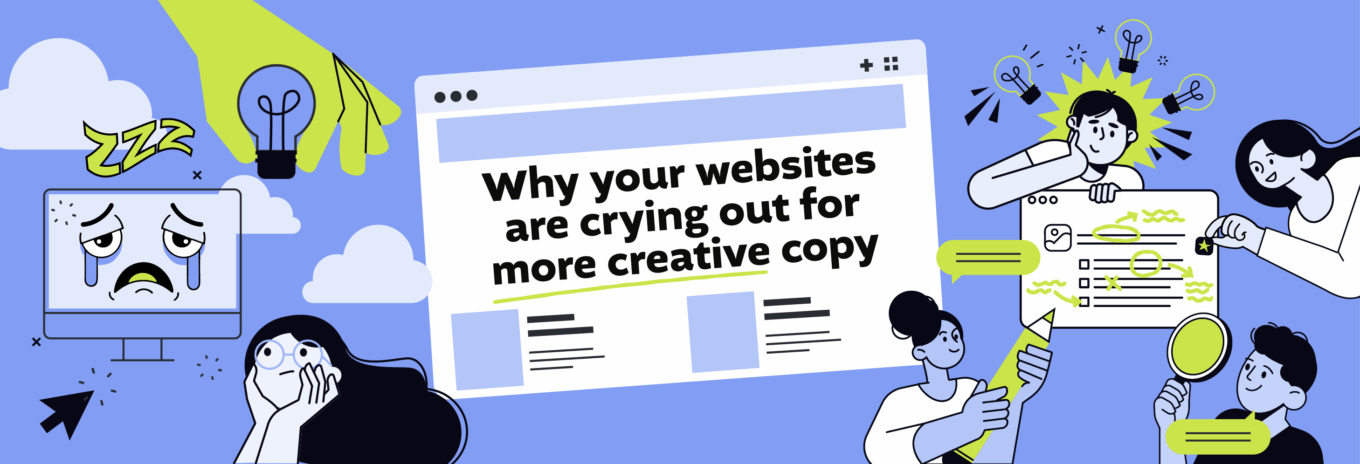
Everyone’s got a website, right?
 It’s still the first place people go when they’re about to buy from you, work with you, trust you or recommend you. Looking good helps, sure. But design alone won’t carry the experience.
Your copy is doing the heavy lifting.
It’s guiding people, building trust, answering questions, easing doubts and helping visitors decide whether they actually want to stick around.
And if your copy isn’t doing that…it could quietly be working against you.
The problem with a lot of website copy
Most websites don’t fail because the business behind them is boring.
They fail because the copy is.
Usually, it falls into one (or several) of these traps:
- it’s outdated
- it’s too vague
- it sounds like everyone else
- it’s overloaded with jargon
- it focuses too much on process instead of people
- it’s technically correct, but emotionally flat.
A lot of organisations accidentally write for themselves instead of the people reading.
We recently worked with the Local Government & Social Care Ombudsman (LGSCO) on a large-scale tone of voice and website content project. Their website dealt with complaints, investigations and highly sensitive situations – so accuracy and impartiality mattered enormously.
But over time, the language had become overly formal, procedural and defensive. Pages were packed with legal terminology, passive language and internal jargon. The information was accurate, but it wasn’t always easy to follow, especially for people already stressed or overwhelmed.
That’s a really common problem.
When organisations become too close to their own processes, their copy often starts sounding cold without them even realising it.
And online, cold copy creates distance.
Copy is only getting more important
 People love predicting the death of web copy.
Apparently nobody reads anymore. Everyone’s scrolling. Attention spans are collapsing. AI is writing everything.
But good copy still matters. Possibly more than ever.
People might skim first, but they’re still looking for signals:
- Can I trust you?
- Do you understand what I need?
- Is this clear?
- Am I in the right place?
Good copy turns a skim into attention. Bad copy sends people bouncing straight back out the door.
That’s why clarity matters so much. Not only cleverness.
With LGSCO, one of the biggest improvements came from simplifying and reframing explanations. Instead of leading with restrictions and policy language, we helped them explain their role more honestly and clearly:
They don’t decide whether a council’s decision was right or wrong – they decide whether the correct process was followed.
That single shift made the organisation feel more transparent, understandable and human. And that’s what strong website copy does. It helps people feel oriented instead of overwhelmed.
Don’t fall into these traps
- Working exclusively with robots
The world is getting increasingly GPT’d, which means standing out is becoming even more important.
AI tools are brilliant for ideas, structure and momentum. But if everyone relies on the same tools in the same way, everything starts sounding weirdly identical: polished, flat and slightly lifeless.
The organisations that stand out will be the ones that still sound human. But that doesn’t mean abandoning technology. It means bringing personality, perspective and emotional intelligence into the process.
Because people connect with people – not perfectly optimised paragraphs. - Confusing clarity with blandness
Some businesses are so worried about sounding “professional” that they accidentally remove all personality from their copy.
Others swing too far the other way and become all style, no substance.
The sweet spot sits somewhere in the middle. You need storytelling and clarity, personality and usefulness, and emotion and information.
With LGSCO, this balance was essential. The content needed to sound warmer and more conversational, without losing authority or impartiality. We weren’t trying to make serious subject matter feel casual. We were helping difficult information feel easier to understand.
 Educate, engage and excite
The best website copy usually does three things:
- Educates
- Engages
- Excites
Not in a loud, “LOOK AT US!” kind of way, but in a way that makes people want to continue the journey.
We’re sometimes told:
“There’s nothing interesting about us.”
Or:
“People don’t care about our team/services/process.”
We disagree.
People absolutely care if you give them a reason to. Nobody wants to read a lifeless “About Us” page written like a corporate hostage note. But people do want to understand your mission, your thinking and what makes you different.
Even organisations dealing with serious or complex topics still need connection and clarity.
In the LGSCO project, tiny wording changes made a huge difference. Replacing overly formal language with more human alternatives helped the organisation feel more approachable without compromising professionalism.
Sometimes the smallest shifts create the biggest emotional impact.
Your website should feel like a conversation, not a document
One of the biggest mistakes businesses make is treating website copy like static information.
But your website is an experience. Your visitors are moving through it making tiny decisions constantly:
- Should I keep reading?
- Do I trust this?
- Does this feel relevant to me?
- Do these people understand what I need?
Good copy helps guide that journey.
It reduces friction, builds momentum, and makes people feel something. It helps people feel understood.
Get inspired
Thinking about rewriting your website copy? Here are a few ways to get unstuck.
- Find what you dislike
When you land on a website and immediately lose interest, ask yourself why.
Is it too generic?
Too corporate?
Too confusing?
Too salesy?
Too robotic?
Understanding what doesn’t work is often the fastest route to discovering what you actually want your own copy to sound like. - Find what you love
Equally, pay attention to websites that pull you in.
What made you keep reading?
What felt different?
What felt clear, confident or engaging?
Dissect it. Good copy isn’t accidental.
Don’t let the blank page win
The blank canvas can feel intimidating. Start messy.
Bullet points are fine.
Half-sentences are fine.
Rambling notes are fine.
You can shape rough ideas into strong copy later.
And sometimes, bringing in an outside perspective helps enormously, especially when you’re too close to the business to see what’s interesting anymore.
Because often, the problem isn’t that your business lacks a story – it’s that your website isn’t telling it very well yet.
Are you interested in revamping your website copy? Give us a shout. We’d love to work together.