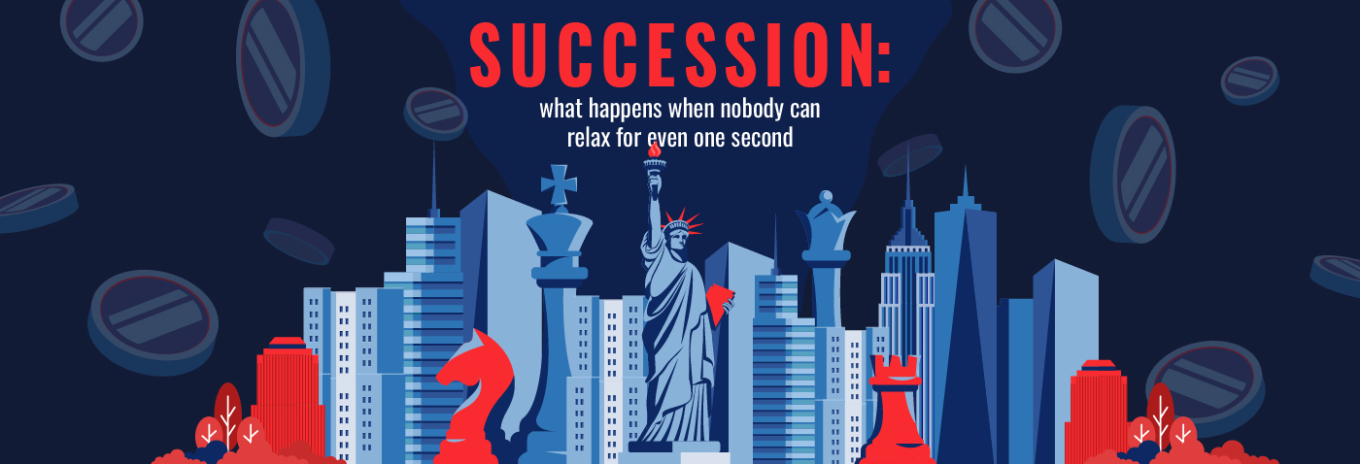
With HBO Max now in the UK, people are revisiting Succession, the HBO series that ran from 2018 to 2023.
On paper, it’s about the Roy family (loosely based on the Murdochs) fighting over control of Waystar Royco, a giant media empire fuelled by money, ego, inheritance, and an almost supernatural inability to have a normal conversation.
But underneath the private jets and hostile takeovers, Succession is really about atmosphere.
More specifically: what it feels like to spend every day in a room where approval can disappear without warning.
Everyone is performing. Everyone is guessing. Everyone is slightly braced for impact.
And honestly… it might be the least psychologically safe workplace ever put on television.
When honesty feels dangerous
 One of the strangest things about Succession is how rarely anyone says what they actually mean.
Even simple conversations feel loaded. A compliment might be a threat. A joke might be a test. A silence might end your career.
Nobody speaks plainly because nobody feels safe enough to.
So communication stops being about clarity and starts becoming about survival. People hedge. Deflect. Probe. Position. Every sentence feels like it’s passed through legal review and emotional warfare at the same time.
You can almost see everyone running live risk assessments in their heads.
Everyone is “high-performing” and deeply stressed
Succession gets described as a show about ambition, but it’s really about vigilance.
Nobody ever settles.
The characters constantly scan for changes in mood, power, status, loyalty. Conversations shift direction mid-sentence depending on who walks into the room. Confidence lasts about twelve seconds before panic sneaks back in.
Which raises an uncomfortable question:
How much of what workplaces call “high performance” is actually just people being permanently on edge?
Because from the outside, vigilance can look a lot like competence – especially in cultures that reward people for never fully relaxing.
Burnout isn’t always about workload
Succession also captures a quieter kind of exhaustion. Not “I have too many emails” exhaustion. More: “I have absolutely no idea where I stand and I’m trying to decode every interaction like it’s a hostage negotiation.”
That kind of uncertainty wears people down fast.
When expectations keep shifting and feedback arrives randomly (or explosively) your nervous system never really powers down. It just stays humming away in the background like a laptop overheating on a duvet.
Eventually, the tiring part isn’t the work itself. It’s the interpretation.
When instability becomes the culture
 The real problem in Succession isn’t that people behave badly sometimes.
It’s that instability becomes the operating system.
When leadership is unpredictable, people become cautious. When status feels fragile, people become political. When outcomes feel arbitrary, people become defensive.
Over time, self-protection replaces honesty.
Nobody focuses on doing good work because everyone is too busy trying not to get emotionally sniped in a conference room.
The disappearance of normal conversation
One of the saddest things in Succession is how little unguarded speech exists.
Even private conversations feel performative. Everyone is managing impressions all the time. People speak in half-finished thoughts, coded jokes, strategic ambiguity.
And after a while, the line between performance and personality starts to blur.
You get the sense that some of the characters genuinely don’t know what they think anymore underneath all the positioning.
Which feels… familiar in more workplaces than we’d probably like to admit.
What psychological safety actually does
Psychological safety can sound like one of those corporate phrases people throw into slide decks next to “synergy” and “blue-sky thinking.”
But its effects are incredibly practical.
It shapes whether people can:
- Ask questions without looking incompetent
- Disagree without fear
- Admit uncertainty
- Think out loud
- Say “I don’t know”
- Bring up problems before they become disasters
When people feel safe, thinking expands. But when they don’t, thinking narrows into self-protection.
Succession just turns that dynamic all the way up until nobody can pretend not to see it anymore.
When smart people stop thinking clearly
One of the most interesting things about the show is that almost everybody is intelligent.
And yet they regularly make terrible decisions. Not because they’re incapable, but because the environment pushes them into defensive thinking. Short-term thinking. Status thinking.
The problem is rarely intelligence, or a lack thereof. It’s what happens to intelligence when people don’t feel safe enough to use it properly.
Without psychological safety, even brilliant people can end up operating in survival mode.
What we mistake for a “strong culture”
 Succession never really gives us a clear moral lesson. It just holds up a very expensive mirror.
Because most workplaces aren’t Waystar Royco.
But plenty still contain smaller versions of the same dynamics:
- unclear expectations
- unpredictable feedback
- unspoken hierarchies
- constant tone-reading
- cultures where people stay careful instead of honest
And from the outside, those environments can still look successful.
Busy people. Sharp suits. Fast decisions. High performance.
But underneath, people are exhausted from trying to stay socially safe.
Psychological safety is the thing that allows people to think clearly, communicate honestly, and do meaningful work without burning cognitive energy on self-protection all day.
That’s a big part of the work we do at Alive – helping teams build cultures where psychological safety isn’t left to chance, but designed into how people communicate, collaborate, and make decisions. Through workshops, conversations with colleagues, and practical support for leaders, we help create environments where people feel safe to contribute and do their best work.
Think we’d work well together? We’d love to hear from you.