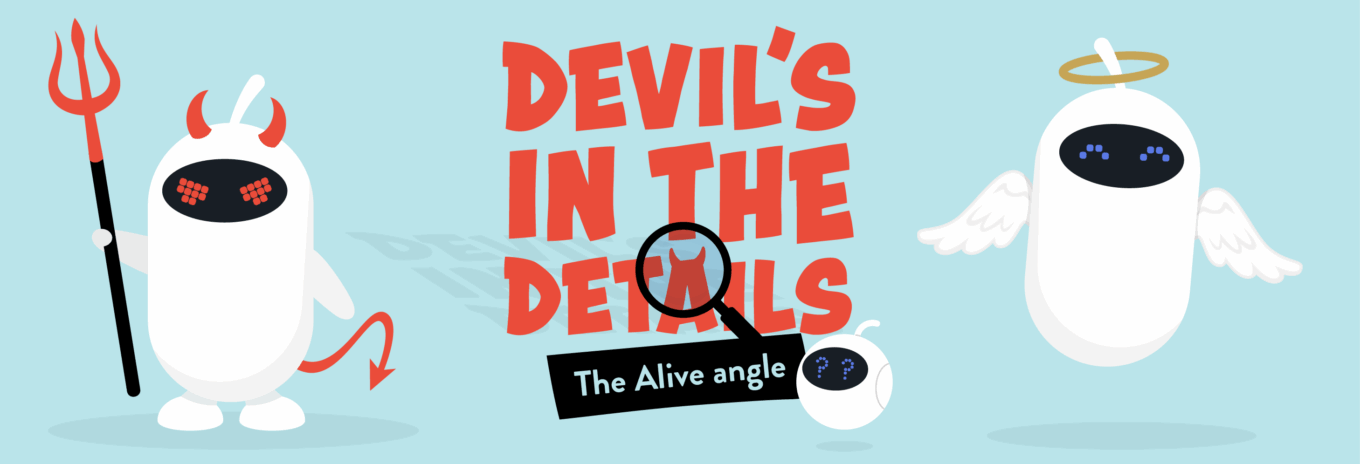
The conversation around AI in design is moving at warp speed. More and more creatives are dipping a toe in, seeing how it can streamline workflows, unlock ideas, or – let’s be honest – cause a bit of chaos. There’s curiosity, excitement, and just a pinch of existential dread.
We sat down with some of the Alive team to hear how AI is reshaping their work, where the benefits lie, and where the boundaries should be.
Rob: If it helps me get there quicker, I’ll use it.
Rob’s approach is all about practicality. Faced with a tight budget and no time for a photoshoot, he turned to Adobe Firefly to generate image variations using stock photos and a reference image. It wasn’t perfect as tweaks were needed, but it gave him a strong jumping-off point, fast.
“I’m not a massive user of AI,” he says, “but when it helps me get there quicker, I’ll use it.”
He’s also a fan of AI tools embedded in familiar software, like Photoshop’s generative fill, and occasionally turns to ChatGPT to summarise tricky documents. But he’s clear: AI is a tool, not the idea. “As long as it’s used as a creative aid and not the reason to do something, I’m OK with it.”
Andy: It’s powerful but it needs boundaries.
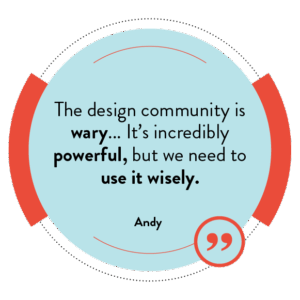
Andy’s warming to AI, carefully. “The design community is wary. Some people are diving in, others are standing back. I’m somewhere in between. It’s incredibly powerful, but we need to use it wisely.”
He recently used AI to bring a pitch idea to life when a traditional shoot wasn’t an option. The outcome was visually strong, but the process took some trial and error.
His concern lies in the perception that AI means instant polish with minimal effort. “Clients might look at that and wonder why they need a designer at all. It’s not perfect, but it’s fast, and that matters.”
His rule of thumb? Let AI support your ideas, not replace them.
Mason: AI isn’t new, but it’s everywhere now.
Mason takes a more cautious stance. Tools like Midjourney and ChatGPT can speed up workflows and help spark ideas, but his biggest worry is accuracy and ethics.
“AI products are being advertised as reflective of real-world users,” he says, “but they don’t always produce factually correct outputs and that can be misleading.” He’s also wary of what happens to the data we feed these tools, especially when working with private client content.
For Mason, design is still fundamentally about human connection. Authenticity matters and right now, AI just doesn’t have the emotional intelligence to deliver that.
Stan’s take: Shrinking the gap between imagination and execution
For Stan, the rise of AI in design feels like a natural evolution similar to when the internet first transformed the industry. “It will change how design is done but not replace it,” he says. “It’ll streamline and speed up parts of the process, but ultimately, it’s still down to a designer’s experiences, ideas, and human understanding of what resonates.”
Stan believes that AI has the potential to reduce the friction between imagination and creation. As platforms like Manus continue to evolve, he sees an exciting opportunity: “AI could take on a lot of the labour-intensive parts of design, which would give creatives more freedom to focus on solving problems in more meaningful, human ways.”
Stan argues that what sets great design apart is not just execution. It’s the insight that comes from lived experience. “There’s an emotional tone, a sensitivity, a story behind every good idea. AI might be able to do something, but it’s our personal history and understanding that help us decide what to do and why.”
Rebecca: It’s a game-changer if you’ve got the skills.
Rebecca’s view is balanced. Personally AI worries her. “I don’t share photos of my kids online because of AI, and the spread of misinformation is scary.” Professionally, though, she sees the value.
“Like Photoshop, it’s a ‘put in, get out’ system. You still need skill to get quality results.”
She’s using AI to do more with less: creating 3D visuals without mastering complex software, refining copy with ChatGPT, and finding image references that don’t exist anywhere else.
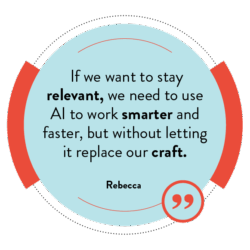
Her verdict is “If we want to stay relevant, we need to use AI to work smarter and faster, but without letting it replace our craft.”
Kat: It’s muddy territory for illustrators.
Kat’s a traditionalist when it comes to illustration. She’s curious about AI’s potential, especially for compositing references, but also deeply uncomfortable with how it’s being used.
“Many artists feel like their work is being automated without consent,” she says, citing a survey by the Association of Illustrators that found 32% of members had already lost commissions to AI.
She also points to Hayao Miyazaki’s infamous critique of AI art. “It’s a real issue.” For Kat, the line between inspiration and exploitation is still far too blurry.
Laura: Whether it’s a threat or tool is up for debate
Laura recently came across a Creative Boom article that got her thinking. AI is here to stay…but whether it’s a threat or a tool is still very much up for debate.
She sees potential in using AI to streamline the repetitive stuff, free up time for big ideas, and get projects moving faster. But she’s clear: AI shouldn’t replace the designer’s eye, or gut instinct.
The real challenge? Striking the right balance between speed and soul where AI helps move things along, without stealing the spark that makes design feel like something.
So… where do we go from here?
AI is transforming the design world, whether we like it or not. It’s accelerating processes, helping us brainstorm, and nudging the edges of what’s possible.
But it also forces big conversations about ethics, originality, data use, and the role of real human creativity in a digital-first future.
The bottom line: AI’s probably not coming for designers’ jobs…but those who know how to play nice with it? They’ll be the ones running the show. And our studio team’s already way ahead of the game.