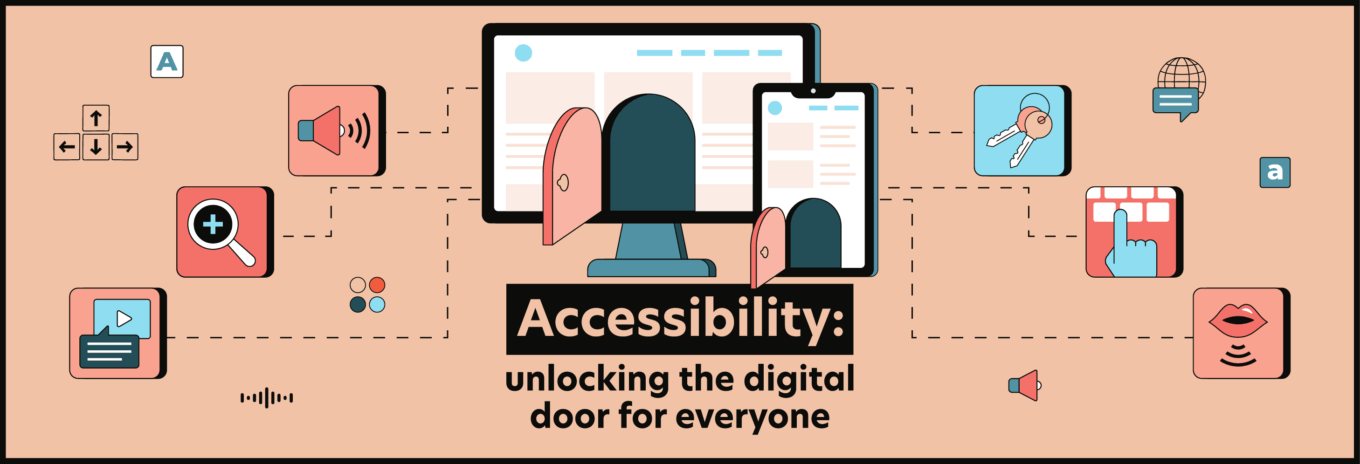
Think about the last time you tried to get through a door that was too heavy, or a form that wouldn’t accept your postcode. Frustrating, right? Now imagine those barriers multiplied across every app, website and digital service you use. That’s the reality for millions of people every day.
Digital accessibility is about removing those invisible barriers and creating digital experiences that work for everyone. And here’s the best part – when we get accessibility right, we don’t just benefit disabled users, we improve the experience for all.
Accessibility is about people, not checklists
One of the biggest takeaways from AbilityNet’s Digital Accessibility Webinar is this: accessibility isn’t about “fixing disabled people”. It’s about fixing the barriers we’ve built into our digital products.
That’s the heart of the Social Model of Disability – people are disabled not by their impairments, but by inaccessible environments. An unlabelled button, a video without captions, a PDF that can’t be read by screen readers – all of these are barriers we’ve chosen to create (often without realising it).
When we take them down, we don’t just open doors. We open opportunities.
Accessibility might feel like a nice-to-have, but the reality is it’s a must-have
- Moral: Inclusive design says loud and clear, we care about people.
- Business: Disabled people represent the world’s largest minority group, with spending power of over £274 billion in the UK alone. Yet 75% say businesses are losing them because of poor digital design.
- Legal: Accessibility isn’t optional. International standards and local laws — like the UK Equality Act 2010 and the Public Sector Bodies Accessibility Regulations — require organisations to make their digital services accessible.
It’s the smart and right thing to do.
More than compliance, it’s about creativity
Accessibility is not about limiting design. It’s about expanding it. By designing for people with diverse needs, we create products that are more usable, more engaging and more resilient.
Think captions that help someone in a noisy café. High-contrast text that works better in bright sunlight. Keyboard navigation that speeds up productivity. Accessibility is innovation disguised as empathy.
A journey, not a tick-box
Accessibility can often be seen as a one-off project you tick off the list. But that’s not correct.
It’s more like gardening: ongoing care, regular attention, and constant improvement. It involves design, content, procurement, policies and, most importantly, people.
Start small. Build awareness. Train your teams. Test with real users. Every step you take removes a barrier and makes your digital spaces more welcoming.
The potential is huge
Accessibility is about potential, not compliance. Potential customers, potential employees, potential impact. When we break down barriers, we give more people the chance to connect, contribute and create.
And that’s good for business, good for society, and good for creativity.
If you’re looking to improve your accessibility standards, give us a shout. We’d love to help.