Let’s be clear.
Send Help is not a corporate training video.
It’s a horror/comedy. It’s exaggerated. It’s stylised. It’s directed by Sam Raimi – a filmmaker known for blending tension, absurdity and dark humour in ways that are not meant to be taken as literal reality.
And yet… sometimes fiction pulls out truths we’d rather not look at directly.
Starring Rachel McAdams (THE Regina King) and Dylan O’Brien (dreamy), the film follows an overlooked employee and her charismatic, entitled, and mean boss who end up stranded together on a remote island after their plane goes down.
Before the plane crash, she’s laughed at. Passed over for promotion. Spoken down to. Sidelined.
He’s confident, influential, and in charge.
But after the crash, he needs her.
And that’s where it got us thinking.
1. The person who often gets overlooked might be the most capable one in the room
In the office scenes, McAdams’ character is competent but invisible.
She’s the one who prepares thoroughly. The one who notices risk. The one who does the work often others can’t.
But she’s not flashy and so she’s passed up.
The film exaggerates the reversal – of course it does. That’s the genre. But the core dynamic is painfully familiar:
Organisations often reward confidence over competence. But on the island, titles evaporate. Capability doesn’t. And suddenly the “not quite leadership material” employee is the one building shelter, managing resources, regulating panic.
The talent was always there, it’s just that the culture failed to recognise it.
 2. Micro-humiliations add up
There’s something particularly uncomfortable about the early workplace moments.
The small laughs. The patronising tone. The polite dismissal. Nothing dramatic enough to file a complaint, but enough to slowly erode someone’s confidence.
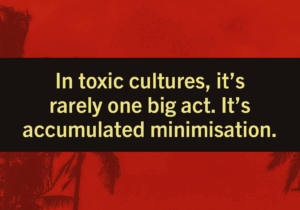
In toxic cultures, it’s rarely one big act. It’s accumulated minimisation.
And Send Help makes you sit with that discomfort before the survival story even kicks in.
Because when the power dynamic flips, you realise the person who was treated as “less than” has been absorbing that treatment for years.
Crisis doesn’t create competence. It reveals it.
3. Positional power is fragile
Dylan O’Brien’s character thrives in structured environments. He knows how to command a room, how to influence perception, and how to perform leadership. And to be fair – that works… until it doesn’t.
Once they’re stranded, the infrastructure that props up his authority disappears. There are no performance reviews, no organisational chart, no strategic plans, and no audience.
Just survival – and survival doesn’t care about your job title.
Raimi plays this shift with dark humour, but the message lands: power that depends solely on structure is fragile.
4. Being passed over changes people
One of the most subtle arcs in the film isn’t revenge. It’s transformation.
Before the crash, she’s tentative. Almost apologetic. Years of being underestimated have shaped how she shows up.
On the island, without that hierarchy pressing down on her, she expands.
Clear, direct, and decisive. It makes you wonder:
How many people in our organisations are operating at 60% of their potential because culture keeps them small?
Toxic workplaces don’t just lose talent. They compress it.
5. Crisis reveals what culture conceals
We know. It’s a horror/comedy. It’s heightened. It’s not meant to be a realistic leadership case study.
But good storytelling – especially in the hands of someone like Sam Raimi – exaggerates dynamics so we can see them clearly. Strip away the island and the survival plot, and what’s left?
An employee who was:
- Undervalued
- Overlooked
- Socially marginalised
And a boss who only recognised her worth when he had no other choice. That’s the uncomfortable part.
Because most workplaces won’t have an island moment.
They’ll have restructures, market downturns, sudden departures, and moments where the “quietly competent” person becomes essential.
 The question is: will you notice their value before you’re forced to?
Conclusion
We’re not suggesting you run your next leadership workshop using horror tropes, but sometimes entertainment holds up a mirror in unexpected ways.
Send Help made us laugh. It made us wince. It made us side-eye a few workplace dynamics we’ve all seen before.
And it left us with one thought: if it takes a disaster for someone’s value to become obvious, your culture was never paying attention in the first place.